
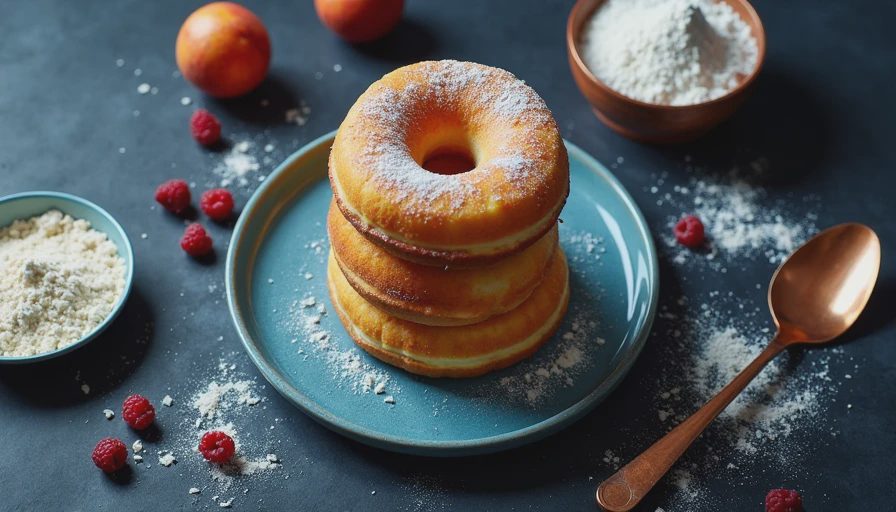
A doughnut cake stack is exactly what I want from a party dessert: soft baked doughnuts, thick vanilla frosting, and enough chocolate glaze to make everyone reach for a napkin. It looks dramatic without requiring a professional pastry kitchen, and the slightly uneven layers are part of its charm. I made mine on a rainy Saturday in Denver while Lily stole two doughnut holes and Mark tried to “taste-test” the frosting three times. It doesn't matter if it's perfect or not, just make it delicious.
This recipe makes a doughnut cake stack with three rings and a generous center filling. You will need a doughnut pan, a piping bag or zip-top bag, and a cooling rack. No stand mixer is necessary. A hand whisk and a little patience will get you there.
What makes this doughnut cake stack work
The structure comes from baked cake doughnuts rather than fried yeast doughnuts. That gives you a firm, tender ring that can support frosting without collapsing. The batter uses 240 grams of all-purpose flour, 150 grams of granulated sugar, 8 grams of baking powder, 2 grams of baking soda, and 3 grams of fine salt. Whisk those dry ingredients together before adding 170 grams of buttermilk, 80 grams of melted unsalted butter, two large eggs weighing about 100 grams without shells, and 8 grams of vanilla extract.
The buttermilk adds acidity and tenderness, while the combination of baking powder and baking soda gives the rings enough lift. If you only have regular milk, stir 5 grams of lemon juice into 170 grams of milk and let it stand for 5 minutes. It will not taste exactly the same, but it works better than guessing with extra baking soda.
Heat the oven to 350°F. Grease a six-cavity doughnut pan thoroughly, especially around the center posts. Mix the batter just until no dry flour remains; a few small lumps are harmless. Transfer it to a piping bag and fill each cavity about two-thirds full. This is less messy than spooning batter around the pan, and it helps the rings bake to a similar height.
Bake for 14 to 17 minutes. The tops should spring back when pressed lightly, and a toothpick inserted near the side should come out with a few moist crumbs. Cool the doughnuts in the pan for 8 minutes, then turn them onto a rack. Let them cool completely before assembling. Warm dough will melt frosting into a sad puddle.
Frosting, glaze, and the parts worth measuring
For the filling, beat 170 grams of softened unsalted butter for 2 minutes. Add 240 grams of sifted powdered sugar in two additions, then mix in 30 grams of heavy cream, 6 grams of vanilla extract, and 2 grams of salt. Beat for another 3 minutes until pale and fluffy. The salt matters. Without it, the frosting tastes like sweet fat instead of vanilla buttercream.
For the chocolate glaze, place 120 grams of chopped semisweet chocolate in a heatproof bowl. Heat 90 grams of heavy cream until steaming but not boiling, pour it over the chocolate, and wait 3 minutes. Stir from the center outward until glossy. If the glaze looks thick, add 5 grams of warm cream. If it looks thin, wait 10 minutes; chocolate thickens as it cools.
A doughnut cake stack is easiest to decorate when the frosting is firm enough to hold ridges. If your kitchen is warm, chill the frosting for 15 minutes. Do not chill it until hard, because cold buttercream tears the cake surface when spread.
How to assemble the stack without a collapse
Choose the three most level doughnuts for the layers. If one ring has a rounded bottom, trim away only the highest bump with a serrated knife. Place the first ring on a flat cake plate or a square of parchment. Pipe a rope of frosting around the outside edge, then fill the center with about 90 grams of frosting. Spread it gently to the inner edge.
Add the second ring and press down with very light pressure. You are joining layers, not squashing a sandwich. Repeat with another 90 grams of filling, then add the final ring. Pipe a thin line of frosting around the top edge and spoon the cooled chocolate glaze into the middle. Let a few drips run over the sides. A little unevenness makes the doughnut cake stack look homemade instead of manufactured.
Finish with sprinkles, crushed cookies, toasted chopped pecans, or small doughnut holes. Add decorations while the glaze is still tacky. If the glaze has set, they will roll off and collect on the plate.

The failure modes I actually see
If the rings spread into flat discs, the batter was probably overfilled or the pan was not greased around the posts. Fill only two-thirds full and use a pastry brush to reach every groove. If the cakes crack, the oven may be running hot, or the batter was mixed too aggressively. An oven thermometer is useful if this happens repeatedly, but you do not need to buy one just to make this dessert once.
If the stack leans, the layers are different heights. This is fixable. Put the tallest ring on the bottom, use frosting to level the next layer, and chill the assembled cake for 20 minutes before glazing. If the frosting slides out, the doughnuts were still warm or the filling was too soft. Scrape away the loose frosting, chill everything, and continue with a thinner layer.
My own first attempt looked like a tiny chocolate landslide because I glazed it before the frosting had set. It tasted excellent and photographed like evidence. The fix was simple: chill the filled stack for 25 minutes, then use glaze that feels warm, not hot, against the bowl.
Make-ahead timing and serving
You can bake the doughnut rings up to one day ahead. Cool them completely, wrap them individually in plastic wrap, and keep them at room temperature. Make the frosting one day ahead as well, then refrigerate it in a sealed container. Let it sit at room temperature for 30 to 45 minutes and beat it briefly before using.
Assembled, the doughnut cake stack is best served the same day. It remains safe and tasty for about 24 hours at cool room temperature, but the rings gradually soften under the frosting. If your kitchen is above 75°F, refrigerate the finished cake and bring it out 30 minutes before serving. Cut it with a small serrated knife, wiping the blade between slices for cleaner layers.
A practical decorating plan
For a birthday, I use chocolate glaze, rainbow sprinkles, and six mini doughnut holes. For a brunch table, brown butter frosting with cinnamon and chopped toasted walnuts feels less sugary. For a holiday version, use white glaze, crushed peppermint pieces, and a small pinch of flaky salt. Keep decorations to three textures so the dessert looks intentional rather than like the baking cupboard fell over.
This doughnut cake stack serves 8 to 10 people, depending on slice size. A slice is rich, so thin wedges are perfectly reasonable. If a ring breaks while you transfer it, do not throw out the whole project. Hide the break inside the frosting, cover the top with glaze, and call it rustic. The dough will forgive you. So will I.
Put on the apron and go ahead and do it. You need ordinary ingredients, one pan, and enough confidence to leave the drips alone. The best doughnut cake stack is not the one with mathematically perfect layers; it is the one that disappears before the coffee gets cold.

No comments yet.